Restaurant owners will open their monthly P&L reports, check the sales and then move down to the bottom and close the report.
Does this sound familiar?
It may be an extremely precise report, but in focusing on just two numbers, it leaves most of its worth in the dust.
They shouldn’t be more dependent on a accounting firm. They should be more confident of their financials. It is not necessary to be aware of every accounting rule and have to spend hours completing invoices. You should know how profit has changed in relation to the cost of food and labor, and the issues that need to be answered next week.
Bookkeeping Chef’s goal is to automate bookkeeping tasks that do not require the time of restaurant owners, while providing customers with more precise financial information they can access.
You must begin looking at the Weekly Numbers and not just month-end numbers.
While restaurants don’t operate in a calendar month, they must still have an P&L. Managers plan the labor for this week. Chefs order food today. Vendors change prices now.
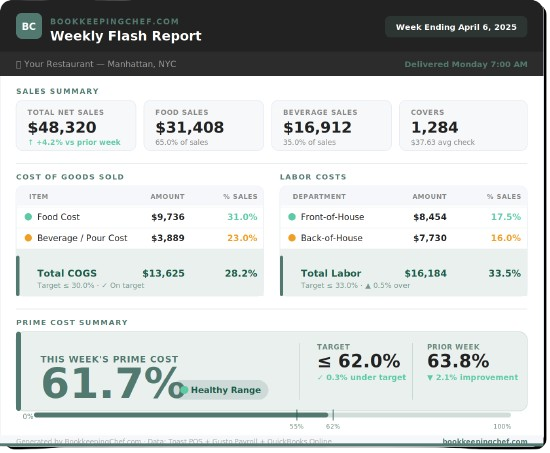
Bookkeeping Chef’s weekly Prime-cost reports are included with the monthly financial statements.
The prime cost comprises two key areas that can be swiftly moved in a food service establishment: the price of the food sold, and the cost of labor. The information provided by the Bookkeeping Chef reveals that prime costs generally account for 60 percent of sales at restaurants.
Imagine that sales barely grew, yet the price of production grew. This percentage isn’t an answer. The owner has an excuse to do some research.
Did hourly work get more expensive? Did overtime take place? Was the cost of food fluctuating? An invoice from a vendor appeared unusually large? Did sales mix changes?
It is better to identify the issue earlier rather than later.
Automate repetitive tasks
DIY bookkeeping doesn’t have to be a manual process of transferring POS totals into spreadsheets after the service.
Modern restaurant bookkeeping automation can take care of a large portion of the routine movement of financial data. It connects to various systems, including POS and QuickBooks, payroll vendors, vendor platforms, inventory and recipe management, as well Payment and AP tools.
The purpose is not to automate for its own sake.
It is to reduce manual data entry and ensure that the financial records up-to-date so that the owners are able to spend their time reviewing information instead of making it.
This creates a new model of bookkeeping in restaurants. The software handles more of the mechanics, while the owner is still involved in the financial aspects.
Learn to Ask the P&L Better Questions
Stop looking at your P&L as the accounting test.
Begin with the sales. Next, examine the costs of production. Compare the effectiveness of drinks and food. Consider labor. Make sure you reduce your operational expenses.
Comparing the time spans is crucial.
Somewhere between these two lines has changed in the event that sales have been increasing, but profits have not. Find out what happened in the operation as food prices increased. Review sales and staffing numbers to determine if the labor percentage has changed. Find out if a figure seems strange, instead of assuming that the restaurant experienced poor times.
Bookkeeping Chef will send monthly P&Ls in five working days. This allows owners to review recent results without having to wait for financial statements, which usually arrive months after the close of an operating period.
For owners searching bookkeeping restaurant solutions, speed is useful but understanding is the bigger objective.
There’s no need to handle everything on your own when you DIY
You can find a happy middle between having someone manage your financial needs as well as being your own accountant full-time.
You could be a part of the business owner, but not have to do every accounting task manually.
It could be as simple as using automated system connections to keep information flowing and analyzing a weekly prime-cost report, analyzing the monthly P&L and asking questions when something is happening unexpectedly.
Specialized restaurant bookkeeping services can support that approach by organizing the books while helping the owner get the meaning of the reports.
It’s not an owner who knows how to perform every bookkeeping function.
Owners can have a conversation with an P&L and have a frank discussion about the company.
The aim is financial independence Not more reports
Restaurants already generate huge amounts of data. A dashboard doesn’t always make sense.
Value is realized when an operator is able to open a P&L report, recognize that there has been a change, and then review the prime-cost reports.
Bookkeeping Chef s approach integrates restaurant accounting automation with daily reports, monthly P&Ls, and special financial assistance for restaurants, making this feasible.
Automate repetitive tasks. Check the primary cost every week. Know the language that is used in your P&L.
There is no need to be an accountant to be an.
You must be an owner who is aware of the financial story of your restaurant.